# VoltPass — Official national and DC charging source snapshots
Saved November 25, 2026 (UTC). Original government page text is attributed below. This is not a live station database or an offline interactive map. Embedded locators returned loading text, not station records. Follow the original links for live maps, current program terms and eligibility. Older announcements and incentives may be outdated. My VoltPass is not affiliated with or endorsed by these agencies.
---
# Joint Office: Electric Vehicle Charging Stations
Live source: https://driveelectric.gov/stations?AutomotiveVentures
[Skip to main content](https://driveelectric.gov/stations?AutomotiveVentures#main-content)

**Official websites use .gov**
A **.gov** website belongs to an official government
organization in the United States.

**Secure .gov websites use HTTPS**
A **lock** (
LockA locked padlock
) or **https://** means you’ve safely connected to
the .gov website. Share sensitive information only on official,
secure websites.
# Electric Vehicle Charging Stations
The Joint Office of Energy and Transportation provides resources to help transportation stakeholders plan electric vehicle (EV) charging infrastructure. The Alternative Fueling Station Locator from the U.S. Department of Energy's [Alternative Fuels Data Center](https://afdc.energy.gov/) shows electric vehicle charging stations in the United States by charging level, access type, station status, and other key data points.
By default, this map displays available and temporarily unavailable direct current (DC) fast and Level 2 chargers for all charging networks and all connector types. To adjust the filters for this map, start by using the "Edit Filters" button.
## [Growth of EV Charging Infrastructure](https://driveelectric.gov/stations-growth)
See the growth of electric vehicle charging ports since 2021.
## [NEVI Awards Dashboard](https://evstates.org/awards-dashboard/)
Learn about EV charging stations funded by the [National Electric Vehicle Infrastructure (NEVI) Formula Program](https://www.fhwa.dot.gov/environment/nevi/).
Loading alternative fueling station locator...
[Return to top](https://driveelectric.gov/stations?AutomotiveVentures#)
- [**About**](https://driveelectric.gov/about)
- [Accomplishments](https://driveelectric.gov/accomplishments)
- [EV Working Group](https://driveelectric.gov/ev-working-group)
- Partners
- [DOE](https://www.energy.gov/)
- [DOT](https://www.transportation.gov/)
- [FHWA](https://highways.dot.gov/)
- [FuelEconomy.gov](https://fueleconomy.gov/)
- [AFDC](https://afdc.energy.gov/)
- [EPA](https://www.epa.gov/)
- [FTA](https://www.transit.dot.gov/)
- [**Who We Help**](https://driveelectric.gov/who-we-help)
- [Industry](https://driveelectric.gov/industry)
- [Riders](https://driveelectric.gov/ride)
- [States](https://driveelectric.gov/states)
- [Communities](https://driveelectric.gov/communities)
- [Tribal Nations](https://driveelectric.gov/tribal-nations)
- [School Districts](https://driveelectric.gov/school-districts)
- [Transit Agencies](https://driveelectric.gov/transit-agencies)
- [**Programs & Services**](https://driveelectric.gov/programs-services)
- [Standards & Reliability](https://driveelectric.gov/standards-reliability)
- [Technical Assistance](https://driveelectric.gov/technical-assistance)
- [Utility Programs](https://driveelectric.gov/utility-programs)
- [Cybersecurity](https://driveelectric.gov/cybersecurity)
- [Data & Analytics](https://driveelectric.gov/data-analytics)
- [Workforce Development](https://driveelectric.gov/workforce-development)
- ## Key Resources
- [Funding](https://driveelectric.gov/funding-opportunities)
- [Infrastructure Playbook](https://driveelectric.gov/ev-infrastructure-playbook)
- [Freight Corridor Strategy](https://driveelectric.gov/files/zef-corridor-strategy.pdf)
- [Community Charging Emerging Practices](https://driveelectric.gov/files/community-emobility-charging.pdf)
---
# DDOT Electric Vehicle Charging Station Program
Live source: https://ddot.dc.gov/page/electric-vehicle-charging-station-program
[Skip to main content](https://ddot.dc.gov/page/electric-vehicle-charging-station-program#main-content)
[Listen](https://app-na.readspeaker.com/cgi-bin/rsent?customerid=6295&lang=en_us&readid=content-start&url=%23markup=https%3A%2F%2Fddot.dc.gov%2Fpage%2Felectric-vehicle-charging-station-program&%23cache%5Bcontexts%5D%5B0%5D=route&%23cache%5Bcontexts%5D%5B1%5D=url.site&%23cache%5Bmax-age%5D=-1 "Listen to this page using ReadSpeaker webReader")
# Electric Vehicle Charging Station Program
The goal of DDOT’s electric vehicle (EV) charging initiatives is to expand curbside charging opportunities in the District to incentivize vehicle owners to switch to an electric vehicle. As a greater number of District drivers make the switch to an EV, DDOT looks to find solutions to meet the charging needs of current and future EV owners. Households, especially those without access to off-street parking, may feel disincentivized to make the switch due to the lack of at-home or nearby charging opportunities. So, these guidelines for covering EV charging cords and DDOT’s curbside EV charging program are designed to proliferate charging opportunities and advance the District’s transportation electrification goals captured in [Clean Energy DC](https://doee.dc.gov/cleanenergydc) and the [Sustainable DC 2.0 Plan](https://sustainable.dc.gov/sdc2).
### Charging Cord Crossing the Public Right-of-Way
DDOT has witnessed an increasing number of residents extending electrical cords across the sidewalk for the purpose of providing a vehicle with a level 1 charge. DDOT reminds residents that extending electric cords across the sidewalk may present a hazard for other users of the public space and compromise accessibility.
### Electric Vehicle Curbside Charging Station Program
As of December 16, 2024, DDOT has closed the permit on the District’s Transportation Online Permitting System (TOPS) to develop accompanying guidelines to the permit regulations that address location, siting, and equipment requirements and to streamline the permit application review process. DDOT will start reviewing permit applications for curbside EV charging stations again after these updates. In the meantime, you can still apply for permits to install EV charging stations in existing off-street parking facilities that are in public space. If there are any updates to this timeline, they will be posted here.
The EV Charging Station Program creates a public space permit available to EV charging station vendors to install a charger at eligible curbside spaces in the District. The stations are required to be dual-port and Level 2 or DC (direct current) Fast Chargers. Eligible curbside spaces include both residential blocks and business corridors to allow charging while at home and while engaging in commercial activities.
At this time, the permit is not available to individual applicants. Residents seeking to install a charger on or around their block are advised to work with their neighbors, their Advisory Neighborhood Commission, and a charging station vendor to identify a location best suited for a charger. See the Frequently Asked Questions for more information.
**For Vendors and Applicants**
Vendors looking to participate in the program should begin by engaging with residents, DDOT, and Pepco to identify suitable locations for a charger. Vendors should schedule a Preliminary Design Review Meeting (PDRM) with DDOT to discuss their charging station plans at [https://tops.ddot.dc.gov/](https://tops.ddot.dc.gov/). At the same time, vendors should begin working with Pepco to discuss the electrification of the proposed site to support a charger. More information about Pepco’s Public Charging Make-Ready Program can be found [here](https://www.pepco.com/SmartEnergy/InnovationTechnology/Pages/ElectricVehicleProgramDC.aspx).
The District’s EV charging station program requires applicants to bring supporting documentation affirming Pepco’s commitment to supporting the charger. Pepco’s role in this process includes upgrading the grid’s capacity, where necessary; connecting the charging station, and acquiring the necessary permits for excavation. Once Pepco has committed to performing the necessary work, the vendor may proceed through DDOT’s permitting process. A detailed workflow outlining the application vetting process is below.
To help vendors identify locations for chargers, an interactive map of relevant curbside restrictions and existing and proposed infrastructure can be found [here](https://dcgis.maps.arcgis.com/apps/webappviewer/index.html?id=899e24ba10984236be045260379cba0b). Proposed locations that conflict with or preclude existing and future curbside priorities may not be accepted.
Complete list of curbside EV Charging Station locations owned, operated, and maintained by DDOT – all addresses listed are within the District of Columbia.
- 1 Level 2 EV chargers with 2 ports total at **2000 14th Street NW**
- 2 Level 2 EV chargers with 4 ports total at **200 2nd Place SE**
Attachment(s):
| | |
| --- | --- |
| | |
---
# DDOT Neighborhood Curbside EV Charging Pilot
Live source: https://ddot.dc.gov/release/ddot-announces-neighborhood-curbside-electric-vehicle-ev-charging-station-pilot
[Skip to main content](https://ddot.dc.gov/release/ddot-announces-neighborhood-curbside-electric-vehicle-ev-charging-station-pilot#main-content)
[Listen](https://app-na.readspeaker.com/cgi-bin/rsent?customerid=6295&lang=en_us&readid=content-start&url=%23markup=https%3A%2F%2Fddot.dc.gov%2Frelease%2Fddot-announces-neighborhood-curbside-electric-vehicle-ev-charging-station-pilot&%23cache%5Bcontexts%5D%5B0%5D=route&%23cache%5Bcontexts%5D%5B1%5D=url.site&%23cache%5Bmax-age%5D=-1 "Listen to this page using ReadSpeaker webReader")
# DDOT Announces Neighborhood Curbside Electric Vehicle (EV) Charging Station Pilot
Tuesday, Feb 10, 2026
**FOR IMMEDIATE RELEASE**
[**Media Contacts**](https://ddot.dc.gov/node/855002 "For the Media")
### **DDOT Announces Neighborhood Curbside Electric Vehicle (EV) Charging Station Pilot**
**(Washington, DC)** — Today, the District Department of Transportation (DDOT), along with the District Department of Energy and Environment (DOEE), announced the Neighborhood Curbside Electric Vehicle (EV) Charging Station Pilot, an initiative designed to expand access to public EV charging in residential neighborhoods across the District. The pilot will help inform future regulatory updates and establish guidelines for a permit program allowing private vendors to install, operate, and maintain curbside EV charging stations in the District’s public right-of-way. The pilot is being deployed in partnership with EV charging company It’s Electric and is funded through a federal grant awarded to the company.
“The District is committed to becoming carbon neutral and climate resilient by 2045. To achieve this, DDOT is working to make it easier for every Washingtonian to choose sustainable transportation options,” said DDOT Director Sharon Kershbaum. “By launching this pilot, DDOT is leading the way in innovation by testing curbside EV charging and sharing best practices with cities across the country.”
“This pilot is an excellent step toward meeting the District’s climate goals,” said Department of Energy and Environment (DOEE) Director Richard Jackson, “And it continues to showcase the Bowser Administration’s commitment to a greener, sustainable future. DOEE is pleased to support this project.”
It's Electric will install, operate, and maintain sixteen (16) curbside chargers serving two (2) adjacent parking spaces in eight (8) locations across the District – one location in each Ward. The first location is open in Ward 1 [next to The Festival Center (1640 Columbia Rd NW) on Mozart Pl NW](https://maps.app.goo.gl/f85B2KobhkdXLjoj7). Advisory Neighborhood Commissions (ANCs) have been consulted in the process of determining the best locations. This and all future locations have been carefully reviewed to ensure safety, accessibility, and compatibility with other street uses. The remaining seven (7) locations will be installed in the coming months.

"Pepco is excited to team up with _It’s Electric_ and DDOT to bring convenient curbside EV charging right to District neighborhoods, making it easier for more residents to consider an electric vehicle as their next car,” said Amber Perry, Pepco's region president. “Through our electric vehicle incentive programs, we’re helping add more publicly available Level 2 chargers across the District, giving people more options to charge up while they go about their day. We’re looking forward to seeing how this pilot serves the community and to working together on even more convenient locations in the future.”
“These curbside chargers are a meaningful step in expanding vehicle electrification in DC. DDOT is delivering innovative transportation infrastructure that demonstrates what cities should do to create sustainable, livable neighborhoods,” **said Judy Chang, Project Director for _It’s Electric_.**
These single-port Level-2 chargers require that users bring their own charging cable. District residents can request a free cable by visiting the _It’s Electric_ app ( [https://www.itselectric.us/for-drivers](https://www.itselectric.us/for-drivers)). Once users make the request to _It’s Electric_, the cable will be delivered by mail within one (1) to three (3) business days.
“We are excited to partner with DDOT, and _It's Electric_ to bring convenient charging to our neighborhood,” **said Bill Mefford, Executive Director at The Festival Center.** “The Festival Center is a hub for mission-driven groups, and we are thrilled to extend our commitment to our community all the way to the curb. _It's Electric's_ business model allows us as the property owner to share in the revenue, which we then can re-invest in our other initiatives.”
This pilot represents a milestone in the Bowser Administration’s efforts to expand access to publicly accessible EV charging infrastructure and create opportunities for District residents to switch to zero-emission vehicles. For more information on the pilot and its progress, please visit [https://sustainability.ddot.dc.gov/pages/pilotprojects](https://sustainability.ddot.dc.gov/pages/pilotprojects).
###
The District Department of Transportation's mission is to equitably deliver a safe, sustainable, and reliable multimodal transportation network for all residents and visitors of the District of Columbia.
Follow us on [X, formerly known as Twitter,](https://twitter.com/DDOTDC) for transportation-related updates and more; like us on [Facebook](https://facebook.com/DDOTDC/) and follow us on [Instagram](https://instagram.com/ddotdc). Visit the website at [ddot.dc.gov](https://ddot.dc.gov/). Visit [goDCgo.com](http://godcgo.com/) for more information on transportation options in the District.
| | |
| --- | --- |
| | |
---
# DOEE Electric Vehicle Resources
Live source: https://doee.dc.gov/service/electric-vehicle-resources
[Skip to main content](https://doee.dc.gov/service/electric-vehicle-resources#main-content)
# Electric Vehicle Resources
[Listen](https://app-na.readspeaker.com/cgi-bin/rsent?customerid=6295&lang=en_us&readid=content-start&url=%23markup=https%3A%2F%2Fdoee.dc.gov%2Fservice%2Felectric-vehicle-resources&%23cache%5Bcontexts%5D%5B0%5D=route&%23cache%5Bcontexts%5D%5B1%5D=url.site&%23cache%5Bmax-age%5D=-1 "Listen to this page using ReadSpeaker webReader")
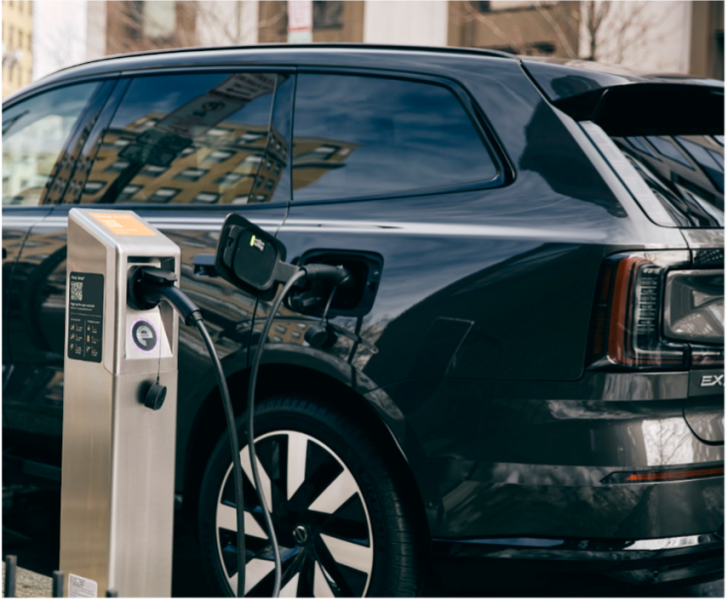Electric vehicles are a cleaner, more sustainable alternative to traditional fossil fuel-powered vehicles. With new charging stations being installed, available financial incentives and lower-cost previously-owned vehicles entering the market, owning or leasing an EV is becoming an increasingly accessible and cost-effective option for District residents.
This page provides information on available resources, incentives, and programs for electric vehicles and EV charging in the District of Columbia.
Contact DOEE staff for more information: [ElectricVehicles@DC.gov](mailto:ElectricVehicles@DC.gov)
* * *
### **What’s New – EVs in the District**
In Early 2026, DOEE staff announced two new programs to expand EV charging across the District:
- The first will expand public charging in parking lots and pilot new curbside charging station concepts with locations in every Ward
- The second will install charging stations to support multi-family home (MFH) residents with rebates of up to 80% of the total installation costs. The MFH rebate program launched on September 16 and runs though **September 2027**. [Find more information about the rebates and how you can participate](https://doee.dc.gov/service/multifamily-EV-charging).
DOEE also worked with DC Council to ensure the District maintains its strong financial incentives for vehicle electrification by extending the Alternative Fuel Infrastructure Credit through 2036. This tax credit can offer individuals 50% of the purchase and installation costs up to $1,000 in tax credits for the installation of a private EV charging station in their home. Businesses can also claim 50% of the costs of purchasing and installing publicly accessible charging stations.
* * *
### **District Transportation Electrification Policies and Legislation**
**The Clean Energy DC Omnibus Act of 2018**
The [Clean Energy DC Omnibus Act of 2018](https://doee.dc.gov/node/1429721 "Clean Energy DC Act") is a foundational piece of legislation that mandates a transition to 100% renewable electricity by 2032 and a zero-emission transportation sector by 2045. The Clean Energy DC Act establishes three main transportation goals:
- 25% or more of all vehicles registered in DC be zero-emission by 2030.
- 100% of all public and school buses are replaced with electric models as they reach the end of their useful life.
- 100% of public buses, public fleets, privately-owned fleets with a capacity of 50 or more passengers, and taxis and limousines are to be zero-emission by 2045 (and 50% zero-emissions by 2030).
**Transportation Electrification Roadmap**
The District adopted the [Transportation Electrification Roadmap (TER)](https://doee.dc.gov/sites/default/files/dc/sites/ddoe/service_content/attachments/Final%20DC%20Roadmap%20sm.pdf), to provide guidance for meeting the three overarching transportation electrification goals in the Clean Energy DC Omnibus Act of 2018. The Roadmap is one part of the District’s larger effort to meet climate goals and energy targets, building towards the goal of becoming carbon neutral by 2045.
**Multifamily Electric Vehicle Charging Assistance Program**
**** The Multifamily Electric Vehicle Charging Assistance Program is a rebate and technical assistance program for multifamily properties in the District. The program offers financial assistance and no-cost technical assistance with the purchase, installation, and maintenance of electric vehicle charging equipment at or near multifamily buildings. [Learn More & Apply >>](https://doee.dc.gov/service/multifamily-electric-vehicle-charging-assistance-program)
**Comprehensive Electric Vehicle Infrastructure Access, Readiness, and Sustainability Amendment Act of 2024.**
Since 2018, DC has expanded the zero-emission transportation framework with the [Comprehensive Electric Vehicle Infrastructure Access, Readiness, and Sustainability Amendment Act of 2024](https://code.dccouncil.gov/us/dc/council/laws/25-262). The Comprehensive EV Infrastructure Act includes key provisions to expand EV charging in DC, including:
- Right to Charge - grants all multifamily home residents the legal right to install EV charging, provided they follow certain safety, installation, building owner approval procedures.
- EV-Ready and EV-Installed Building Mandates - requirements to include infrastructure to accommodate onsite EV charging in new or substantially improved commercial, multi-unit, and single-family home buildings.
- Gas Station Fast Charging - Requires high-volume retail gas stations (selling more than one million gallons per year) to install at least one DC fast-charging port during major renovations.
- Neighborhood EV Charging Infrastructure Pilot Program - established to increase publicly accessible EV charging in priority areas across the District.
Full enforcement of the Comprehensive EV Infrastructure Act remains subject to the remaining funding’s inclusion in an approved budget and financial plan.
### **District EV Dashboard**
The District EV Dashboard is an interactive tool designed to track the District’s progress toward transportation electrification goals by providing data on EV registrations and public charging infrastructure. The dashboard allows users to locate public EV chargers, filter data by charger type, and view EV registrations by ward.
[__](https://experience.arcgis.com/experience/d120564ef5574dbe8493b75ae6462f52/page/EV-Metrics?views=Find-a-Public-EV-Charger)
_Click the above image above to access the District EV Dashboard._
This dashboard is updated quarterly to reflect the most up to date information about EV registrations in the District.
### **Financial Incentives and Local Resources for EVs and EV Charging**
Governments and utility companies offer financial incentives designed to lower the cost of electric vehicles and EV charging.
Listed below are federal, District, and utility company financial incentives available to District residents and businesses.
# Electric Vehicle Incentives
**District Incentives**
**Alternative Fuel Conversion Credit**
The District offers an income tax credit, known as the Alternative Fuel Conversion Tax Credit, to individuals and businesses that convert vehicles to operate on qualified alternative fuels. Eligible taxpayers may claim an income tax credit of 50% of the equipment and labor costs for a conversion, up to $19,000 per vehicle (uncapped for certain businesses). This tax credit is non-refundable and leftover amounts cannot be carried forward to future tax years.
Qualified alternative fuels include ethanol blends of at least 85%, natural gas, compressed natural gas, liquefied natural gas, liquefied petroleum gas, biodiesel (excluding kerosene), electricity, or hydrogen.
The District’s Alternative Fuel Conversion Credit expires on December 31, 2026. More information is available on the [DC Office of Tax and Revenue website](https://otr.cfo.dc.gov/publication/alternative-fuel-vehicle-infrastructure-and-conversion-credits-faqs).
**Reduced Vehicle Registration Fees**
Battery electric vehicles are eligible for reduced vehicle registration fees in the District.
For the initial two-year registration period with the District Department of Motor Vehicles (DMV) new battery electric vehicles less than 5,000 lbs. qualify for a reduced registration fee of $40.
After two years, battery electric passenger vehicles are treated according to their vehicle weight class, but may subtract 1000 lbs. from their manufacture’s weight and pay the applicable annual fee.
Plug-in hybrid electric vehicles and hybrid vehicles do not qualify for reduced vehicle registration fees.
More information on vehicle registration fees is available on the [DMV website](https://dmv.dc.gov/node/155452).
**Reduced Excise Tax**
An excise tax is a one-time fee paid when a vehicle is first titled in the District. Instead of using a flat rate, the District uses a sliding scale to tax vehicles based on vehicle weight and fuel efficiency, with more fuel-efficient and lightweight vehicles paying less in excise taxes.
Electric vehicles pay reduced excise taxes, ranging from 1% - 3% of the vehicle’s fair market value, depending on vehicle weight. Prior to February 2025, fully electric vehicles were exempt from the excise tax.
High-efficiency vehicles, such as plug-in hybrid and hybrid vehicles, or gas-powered vehicles that have a fuel efficiency of at least 40 miles per gallon city driving, also qualify for lower excise tax rates, between 1.5% - 3.5% of the vehicle’s fair market value, depending on vehicle weight.
Heavier and less fuel-efficient vehicles pay an excise tax rate between 5% - 11% of the vehicle’s fair market value, depending on vehicle weight.
The reduced excise tax only applies to newly registered vehicles and does not apply to vehicle leases.
More information about excise tax fees is available on the [DMV website](https://dmv.dc.gov/node/155452).
# EV Charging Incentives
**Federal Incentives**
**Alternative Fuel Vehicle Refueling Property Credit**
The Federal government offers an income tax credit, known as the Alternative Fuel Vehicle Refueling Property Credit (Section 30C), to individuals, businesses, and tax-exempt entities for the purchase and installation of EV charging stations and other alternative fuel infrastructure in eligible census tracts.
Residential claimants can receive 30% of hardware and installation costs, up to $1,000 per charging port.
Businesses and tax-exempt entities can claim between 6% - 30% of hardware and installation costs, up to $100,000 per port, depending on wage and apprenticeship requirements.
This federal tax credit is scheduled to expire on June 30, 2026. All equipment must be fully installed and placed in service by this date to be eligible. To claim the tax credit, taxpayers must file IRS Form 8911 with their federal income tax return for the year the installation was completed.
More information on the Federal Alternative Fuel Vehicle Refueling Property Credit (Section 30C) can be found on the [US Internal Revenue Service website](https://www.irs.gov/credits-deductions/alternative-fuel-vehicle-refueling-property-credit).
Additional federal incentives can be found at the US Department of Energy Alternative Fuels Data Center’s [Federal and State Laws and Incentives database](https://afdc.energy.gov/laws).
**Local Incentives**
**Alternative Fuel Infrastructure Credit**
The District offers an income tax credit, known as the Alternative Fuel Infrastructure Credit, for residents and businesses that purchase and install alternative fuel storage, dispensing, or charging equipment within the District.
Individual taxpayers who install EV charging equipment on a residential property can claim 50% of allowable equipment and installation costs, up to $1,000 per charging station.
Unincorporated businesses that install EV charging equipment that is available for use by the public on a non-residential property can claim 50% of allowable equipment and installation costs, up to $10,000 per charging station.
Corporations that install EV charging equipment that is available for use by the public on a non-residential property can claim 50% of allowable equipment and installation costs, with no cap on the amount that can be claimed per charging station.
The infrastructure credit cannot exceed the taxpayer’s liability in the year it is claimed, however, any unused portion of the tax credit may be carried forward for up to two years.
DC’s Alternative Fuel Infrastructure Credit expires on December 31, 2036. More information on how to claim this credit is available in the [Alternative Fuel Vehicle Infrastructure and Conversion Credits FAQ](https://otr.cfo.dc.gov/page/alternative-fuel-vehicle-infrastructure-and-conversion-credits-faqs) on the DC Office of Tax and Revenue website.
**Utility Incentives**
**Pepco Residential Whole House Time-of-Use Rate**
Pepco, the public electric utility company in DC, offers a Whole House Time-of-Use (TOU) Rate for residential customers with an EV charger.
The TOU Rate is lower than the Standard rate during off-peak hours while slightly higher during peak hours, allowing customers with an EV charger to save money while electricity rates are lower, potentially lowering their monthly electricity bill.
District residents with an EV capable of traveling 30 miles using electricity as fuel, without the use of gas and who register their vehicle in the District can apply for the Whole-Home Time-of-Use Rate through Pepco.
More information on the Residential Whole House Time-of-Use Rate and how to apply is available on the [Pepco DC website](https://www.pepco.com/smart-energy/innovation-technology/dc/electric-vehicles/residential-time-of-use-rate).
# EV Charging Service Providers
Contractors on this list have been verified by the Department of Licensing & Consumer Protection (DLCP) to have, at the time of its creation, active and proper business licensing to perform EV charging equipment installation services in the District. This list was last updated in July 2024. [Contact information for the contractors](https://doee.dc.gov/sites/default/files/dc/sites/doee/service_content/attachments/EV%20Charger%20Service%20Providers.pdf) (also listed below) are available. The DC Government does not endorse nor sponsor any of the listed companies. If you would like to be added to the list of contractors, please email: [nyekah.washington@dc.gov](mailto:nyekah.washington@dc.gov).
| | | | |
| --- | --- | --- | --- |
| **Company** | **Residential** | **Commercial** | **Multifamily** |
| Blue Whale EV | X | X | X |
| Citizen Energy, LLC | X | X | X |
| DaiTechCorp | X | X | X |
| District Fleet e-Mobility | | X | X |
| ENGIE Service US Inc. | | X | |
| Green Compass | | | |
| JLL | X | X | X |
| Lightility, LLC | | X | X |
| SKYHOOK Solar Corp | X | X | X |
| Sunpower by EDGE Energy | X | | X |
# EV Workforce Development Programs
The following is a list of local workforce development programs and trainings for those looking to gain certifications and job training in the EV industry.
\*The DC Government does not endorse nor sponsor any of the listed programs.
| | | | | |
| --- | --- | --- | --- | --- |
| **Program** | **Description** | **Duration** | **Requirements** | **Estimated Cost** |
| [Carroll Community College:](https://www.carrollcc.edu/programs/professional-skills-job-training/hybrid-electric-technician/)
[Hybrid/EV Technician Program](https://www.carrollcc.edu/programs/professional-skills-job-training/hybrid-electric-technician/) | Job training program where students learn how to diagnose and safely repair hybrid and electric vehicles | 2-3 months | Must be 18+ and have a valid driver’s license | $779
Cost deductions available for Carroll County and Maryland residents |
| [District of Columbia Sustainable Energy Utility (DCSEU):](https://www.dcseu.com/workforce-development)
[Workforce Development Program](https://www.dcseu.com/workforce-development) | Paid externships and trainings with local contractors and organizations | 5 months | DC resident | N/A |
| [Electric Vehicle Infrastructure Training Program](https://evitp.org/training/) | Training for installing EVSE equipment and an overview of the EV industry | 20 hours course with exam | Must be a state licensed or certified electrician to participate | $275 |
| [Hagerstown Community College:](https://www.hagerstowncc.edu/electric-vehicle-technician-certificate)
[EV Technician Certificate](https://www.hagerstowncc.edu/electric-vehicle-technician-certificate) | Improve technical knowledge to diagnose, service and repair high voltage EVs | Online,
self-paced, independent study program | No background in auto mechanics required | ~$1800 plus registration fees
[Program Costs](https://hagerstown-gbc.com/highlights/program-costs) |
| [Prince George’s Community College:](https://www.pgcc.edu/sewdp/)
[Sustainable Energy and Workforce Development Program](https://www.pgcc.edu/sewdp/) | Occupational skills and work-based learning to prepare students for employment in renewable energy industry | Varies | Prince George’s County resident, possess high school diploma or GED, and have experience in the energy sector | Courses are tuition free for Prince George’s County residents |
**Other Information Resources**
Other informational resources on EVs, EV charging infrastructure, and incentives that may be beneficial for District residents are listed below:
- [US Department of Energy Vehicle Cost Calculator](https://afdc.energy.gov/calc/): The US Department of Energy has a vehicle cost calculator that uses basic information about driving habits to determine the total cost of ownership and emissions for makes and models of most vehicles.
- [US Department of Energy EV Charging Station Locator](https://afdc.energy.gov/fuels/electricity-locations#/find/nearest?fuel=ELEC): The US Department of Energy maintains an interactive database of publicly accessible charging stations in the United States and Canada.
- [Virginia Department of Energy Transportation Programs](https://energy.virginia.gov/renewable-energy/Transportation.shtml): Learn more about electric vehicle and EV charging programs available to Viriginia residents and businesses.
- [Maryland Energy Administration Clean Transportation Incentives](http://energy.maryland.gov/transportation/Pages/incentives.aspx): Learn more about electric vehicle and EV charging programs available to Maryland residents and businesses.
Attachment(s):
Contact TTY:
711
Related Content:
[Resources for Residents](https://doee.dc.gov/service/resources-residents)
[Resources for Sustainable Businesses](https://doee.dc.gov/service/resources-sustainable-businesses)
| | |
| --- | --- |
| | |
| | |
| --- | --- |
| | |
---
# AFDC Electric Vehicle Charging Station Locations
Live source: https://afdc.energy.gov/fuels/electricity-locations#/find/nearest?fuel=ELEC
# Electric Vehicle Charging Station Locations
Find electric vehicle charging stations in the United States and Canada.
Loading alternative fueling station locator...
---
# DOE National EV Charging Network
Live source: https://www.energy.gov/topics/national-ev-charging-network#/analyze?country=US&fuel=ELEC&status=E&status=T&show_map=true&show_corridor_stations=false
[Skip to main content](https://www.energy.gov/topics/national-ev-charging-network#main-content)

**Official websites use .gov**
A **.gov** website belongs to an official government organization in the United States.

**Secure .gov websites use HTTPS**
A **lock** ( LockLocked padlock
) or **https://** means you’ve safely connected to the .gov website. Share sensitive information only on official, secure websites.
# National EV Charging Network
The US transportation sector is critical to the national economy and the daily lives of all Americans. Transportation is also the second highest expense for a typical US Household and significant source of emissions in the United States. Electrifying road transport can reduce the cost to operate and maintain vehicles for individuals and business while also reducing emissions and improving air quality. A national EV charging infrastructure network will support all Americans and provide additional choices for how people and goods can move across the country.
## Highlights
- [Find out how and where the public charging options continue to grow \\
(link is external)](https://driveelectric.gov/stations-growth)
About 80 percent of charging happens at home. When you’re on the go, you can use public charging options which continue to open across the country.
[Learn More\\
(link is external)](https://driveelectric.gov/stations-growth)
November 8, 2024
- [Discover the standards working behind the scenes to design an EV ecosystem where any vehicle can charge at any location. \\
(link is external)](https://driveelectric.gov/news/j3400-recommended-practice)
A good charging experience is one that is safe and reliable. Public agencies and private sector organizations are collaborating on standards related to adapters and charging connectors.
[Learn More\\
(link is external)](https://driveelectric.gov/news/j3400-recommended-practice)
November 8, 2024
- [Learn how research is setting the stage for a better EV charging.\\
(link is external)](https://driveelectric.gov/chargex-consortium)
How do we make progress toward a charging experience that works the first time? See the latest research from scientists and private sector experts on areas like payment processing, user interface experience, vehicle to charger communication, and diagnostic data sharing.
[Learn More\\
(link is external)](https://driveelectric.gov/chargex-consortium)
November 8, 2024
Accelerating an electrified transportation system that is affordable, convenient, equitable, reliable, and safe.
We are working with states, communities, and the private sector to build a national, interoperable EV charging network. This means that the growing network of public chargers benefits from a shared set of agreed-upon reliability, accessibility, speed, and security standards. In other words, we’re aiming to make it easy to choose mobility options, whether you’re in an urban area or rural town.
This effort includes:
- Providing technical assistance to states, communities, tribal governments, transit agencies, and school districts.
- Advancing standards and reliability on everything from charging software application program interfaces (APIs) to charger uptime.
- Creating tools based on proven data sets to help deploy EV charging infrastructure.
- Developing options and programs that support new private sector business models, community and urban charging, and electric utility infrastructure utility programs and policies.
## Quarterly Update: Public Charging Infrastructure
The National Electric Vehicle Infrastructure (NEVI) Formula Program provides funding to states to strategically deploy EV charging infrastructure and to establish an interconnected network to facilitate data collection, access, and reliability. The Joint Office of Energy and Transportation provides quarterly updates on this program including data on publicly available charging ports, State award, and deployment progress.
[Latest Quarterly Update(link is external)](https://driveelectric.gov/news/q3-2024-nevi-quarterly-update)
Video Url
Find out how the Joint Office of Energy and Transporation plans to reduce carbon emissions within the U.S. by 2050.
Joint Office of Energy and Transportation
## Press Releases
[View all](https://www.energy.gov/collection/view?paragraph=797115)
## From Our Blogs
[View all](https://www.energy.gov/collection/view?paragraph=797001)
## Partnering Offices
- [Office of Critical Minerals and Energy Innovation](https://www.energy.gov/cmei/office-critical-minerals-and-energy-innovation)
November 16, 2026
Loading alternative fueling station locator...
This was last updated October 16, 2025.
Note - Interaction with this form and collection of this data is implied consent.
Did you find what you were looking for?
Yes
No
How can we help you find what you need?
Leave this field blank